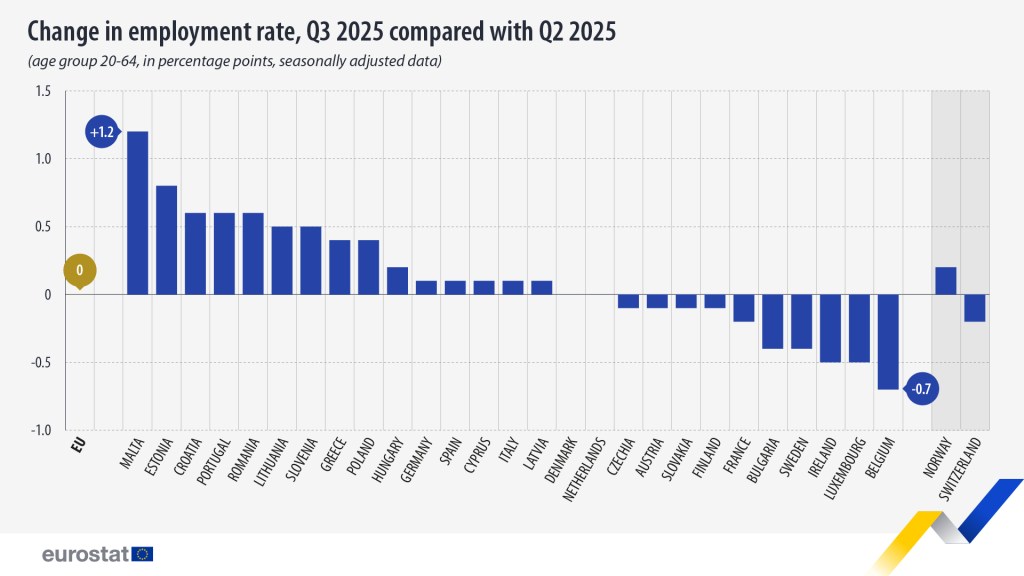
Malta reported the biggest increase in employment rate in the European Union in the third quarter of this year, with employment rising by 1.2 percentage points compared to the previous period, new data from Eurostat has revealed.
According to the data, other countries to report a notable increase in employment rate, on a quarter-on-quarter basis, included Estonia (+0.8 percentage points), Croatia (+0.6 percentage points), Portugal (+0.6 percentage points) and Romania (+0.6 percentage points).
Increase in employment rate
Some 15 countries reported a quarter-on-quarter increase in employment rate, with two – Denmark and the Netherlands – seeing employment stable compared to the previous quarter.
The employment rate decreased in ten EU countries in the third quarter, with the biggest declines reported in Belgium (-0.7 percentage points), Luxembourg (-0.5 percentage points) and Ireland (-0.5 percentage points).
Across the EU as a whole, the employment rate (of people aged between 20 and 64 years of age) stood at 76.2% in the third quarter, stable compared with the previous quarter.
Labour market slack
Labour market slack, meanwhile, which includes all persons who have an unmet need for employment, including unemployed people, stood at 11.0% of the extended labour force in the period, again stable with the previous quarter.
On a quarter-on-quarter basis, labour market slack increased in 13 EU countries, with the biggest increases seen in Slovenia (+1.3 percentage points), Bulgaria (+0.6 percentage points) and Finland (+0.6 percentage points). The largest decrease in labour market slack was reported in Belgium (-0.7 percentage points), followed by Ireland (-0.5 percentage points) and Luxembourg (-0.5 percentage points). Read more here.