Austria produced some 90.1% of its electricity from renewable sources in 2024, followed by Sweden (88.1%) and Denmark (79.7%), new data from Eurostat has found.
Most of Austria’s renewable energy was produced from hydropower, with Sweden largely relying on hydro and wind, and Denmark relying mostly on wind.
More than half
Other countries to report more than half of their electricity produced by renewables included Portugal (65.8%), Spain (59.7%), Croatia (58.0%), Latvia (55.5%), Finland (54.3%), Germany (54.1%), Greece (51.2%) and the Netherlands (50.5%).
At the other end of the scale, meanwhile, Malta produced just 10.7% of its electricity from renewables in 2024, followed by Czechia (17.9%), Luxembourg (20.5%), Hungary (24.1%), Cyprus (24.1%) and Slovakia (24.9%).

Electricity from renewables
Overall, across the European Union, renewable energy was responsible for 47.5% of gross electricity consumption for the year, an increase of 2.1% on the previous year.
This is a notable increase on the 15.9% of electricity produced from renewable sources in 2004, indicating the level to which the bloc has sought to future-proof its energy systems. According to Eurostat, the share of electricity from renewables has almost tripled since its estimates began.
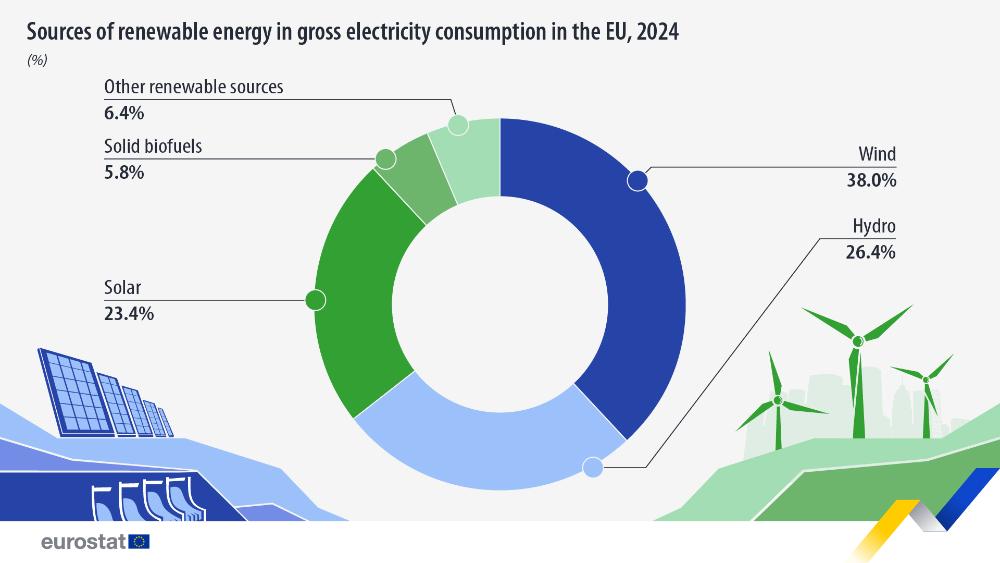
Wind (38%) and hydropower (26.4%) together accounted for close to two thirds of the total electricity generated from renewables in 2024, followed closely by solar (23.4%). Biofuels (5.8%) and other renewable sources (6.4%) also contributed to the total, Eurostat noted.
Solar power is the fastest-growing source of renewable electricity in Europe, growing from just 7.4 terawatt hours (TWh) in 2008 to 304 TWh in 2024. Read more here.