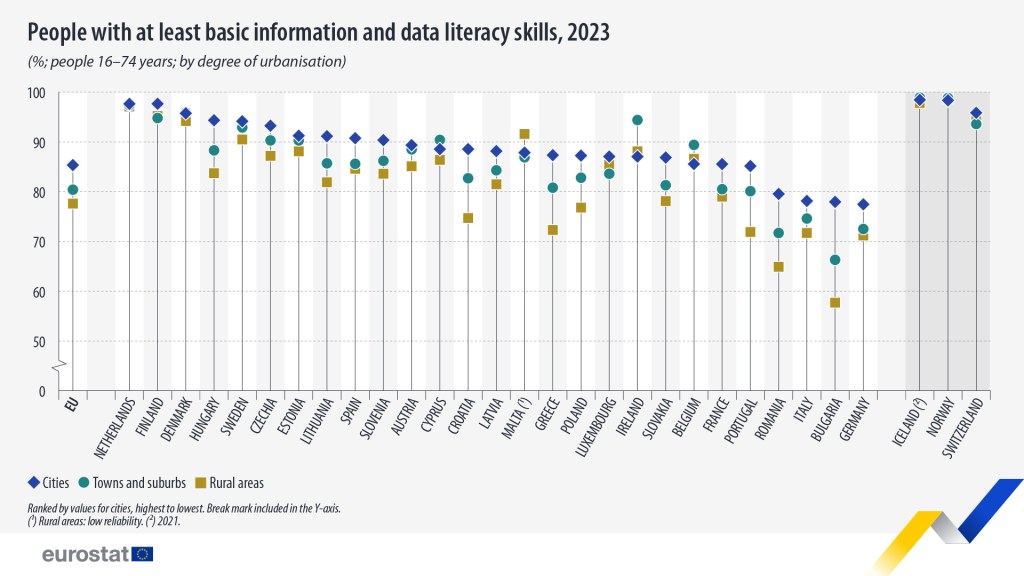
Some 85.4% of the population (aged between 16 and 74) living in cities across the European Union have at least basic data literacy skills, new data has shown.
This is a higher percentage than among those living in towns and suburbs (80.4%) and in rural areas (77.6%), the 2023 data from Eurostat found.
In 22 EU member states, city dwellers boasted the highest data literacy skills, however, in four countries – Denmark (95.9%), Ireland (94.4%), Cyprus (90.4%) and Belgium (89.4%) – the percentage was higher among town and suburb dwellers.
In Malta, the highest share of those with data literacy (91.6%) was recorded among rural dwellers, although this data isn’t necessarily reliable, Eurostat noted.
City dwellers
The highest share of city dwellers with at least basic data literacy was recorded in the Netherlands (97.7%), Finland (97.7%) and Denmark (95.8%), with the Netherlands also boasting the highest shares across both other levels of urbanisation – 97.4% among those living in towns, and 97.1% in rural areas.
At the other end of the scale, Germany (77.5%), Bulgaria (78.0%) and Italy (78.2%) boasted the lowest percentage of city dwellers with at least basic data literacy skills.
Town and rural dwellers
In terms of town and suburb residents with basic data literacy skills, Bulgaria (66.3%), Romania (71.7%) and Germany (72.5%) registered the lowest shares, with the same countries also boasting the lowest percentages of rural dwellers with data literacy skills.
Bulgaria recorded just 57.7% of rural residents with basic skills, with Romania on 64.9% and Germany on 71.2%.
Eurostat published the data on 8 September to coincide with International Literacy Day. Read more here.