The European Union imported €478 billon worth of high-tech products last year from non-EU countries, roughly on a par with the previous year (-0.2%), and exported €501 billion, an increase of 8.1%.
This ensured that the trade balance for high-tech goods in the EU returned to a surplus last year, of €23 billion, following four years of trade deficits. The previous year, the trade deficit stood at €15 billion.
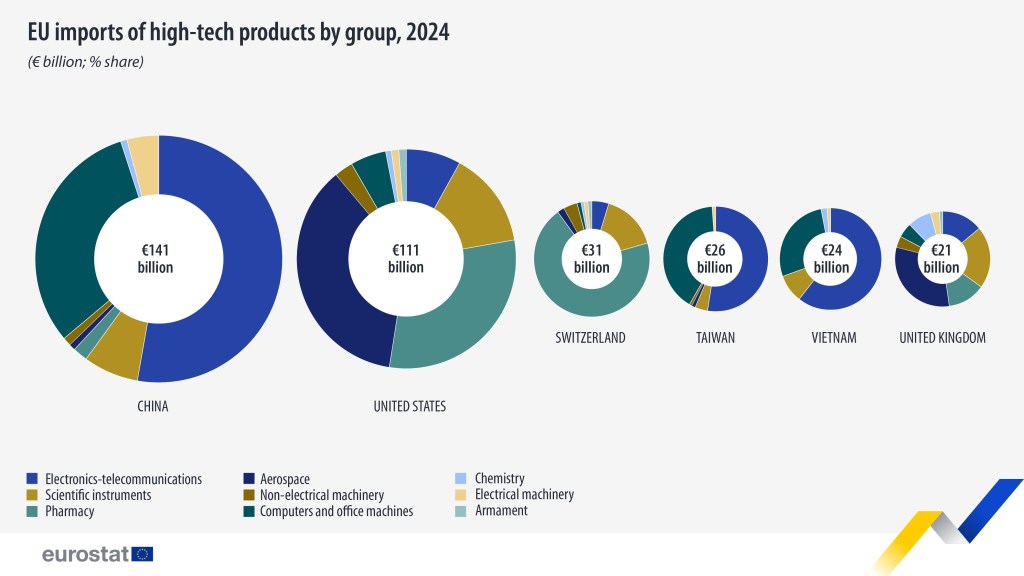
More than half of the EU’s high-tech imports came from China (30%) and the United States (23%), with these markets accounting for €141 billion and €111 billion of imports, respectively.
Other top trading partners included Switzerland (6%), Taiwan (6%), Vietnam (5%), and the UK (4%), Eurostat’s data showed.
Different countries were responsible for different sectors within the high-tech trade environment, with electronics and telecommunications dominating imports from China, Taiwan, and Vietnam, while pharmaceutical-related products largely came from Switzerland.
Elsewhere, aerospace products accounted for a significant level of imports from the US and UK.
High-tech exports
On the export side, the United States was the EU’s largest partner (€156 billion, 31%) last year, followed by China (€49 billion, 10%) and the UK (€48 billion, 10%).
Pharmaceuticals represented 33% of EU high-tech exports, with electronics-telecommunications (19%) and aerospace (18%) the next largest categories.
The US received the bulk of EU pharmaceutical exports, while China mainly imported electronics-telecommunications and the UK received the largest share of aerospace products.
‘The largest exported category for China (32% of high-tech exports; €15 billion) was electronics-telecommunications, while for the United Kingdom (22%; €10 billion) and Türkiye (37%; €5 billion) it was aerospace,’ Eurostat noted. Read more here.
Read more: Germans have little concern about AI impact on job opportunities