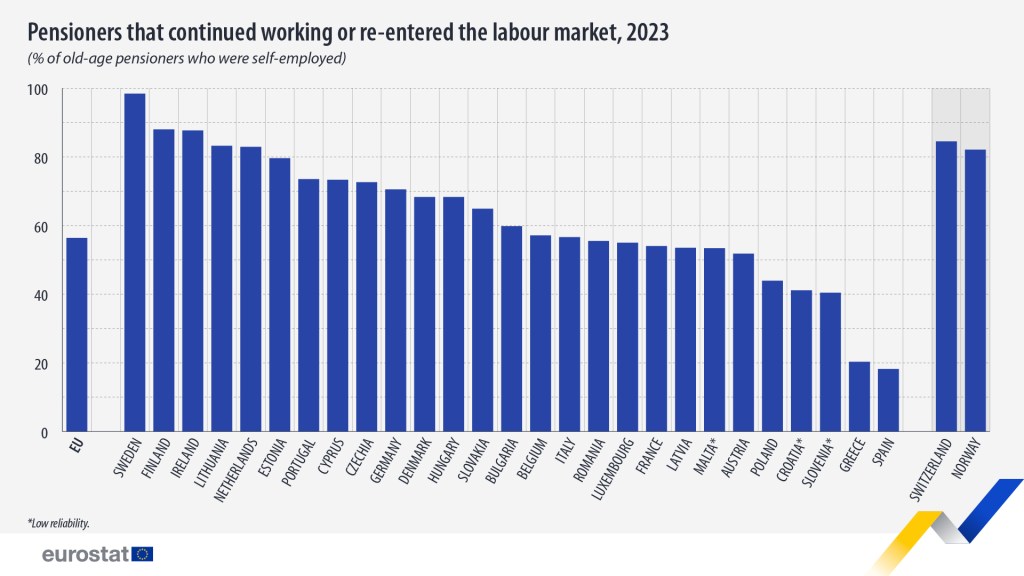
Some 98.4% of Swedish self-employed individuals continue working after receiving their first old-age pension, the highest rate in the European Union.
Other countries in which a high percentage of self-employed old-age pensioners continue in the workforce include Finland (88%), Ireland (87.7%), Lithuania (83.2%) and the Netherlands (82.9%), the Eurostat data, covering the year 2023, showed.
At the other end of the scale, less than a fifth (18.2%) of self-employed Spaniards remain in the workforce, followed by Greece (20.3%), Slovenia (40.4%) and Croatia (41.1%).
Continuing to work
Overall, on a pan-EU level, 56.4% of self-employed pensioners continued in the workforce after receiving their pension.
As of 2023, some 10.2% of old-age pensioners were employed, with the majority of these (57%) working part time.
Croatia had the highest share of part-time employed old-age pensioners (89.4%), followed by Sweden (79.2%) and Belgium (78.0%). Conversely, Bulgaria had the lowest percentage of part-time employed old-age pensioners (9.2%), Eurostat‘s data showed. Read more here.
Percentage of Self-Employed Old-Age Pensioners Still in the Workforce (%)
| Country | % Remaining in Workforce |
|---|---|
| Sweden | 98.4 |
| Finland | 88.0 |
| Ireland | 87.7 |
| Lithuania | 83.2 |
| Netherlands | 82.9 |
| Estonia | 79.6 |
| Portugal | 73.5 |
| Cyprus | 73.3 |
| Czechia | 72.6 |
| Germany | 70.5 |
| Denmark | 68.3 |
| Hungary | 68.3 |
| Slovakia | 64.9 |
| Bulgaria | 59.8 |
| Belgium | 57.1 |
| Italy | 56.6 |
| Romania | 55.5 |
| Luxembourg | 55.0 |
| France | 54.0 |
| Latvia | 53.5 |
| Malta | 53.4 |
| Austria | 51.8 |
| Poland | 43.9 |
| Croatia | 41.1 |
| Slovenia | 40.4 |
| Greece | 20.3 |
| Spain | 18.2 |