Romania has maintained its leadership in electric vehicle (EV) adoption in Central and Eastern Europe, with an EV network closely approaching the EU average.
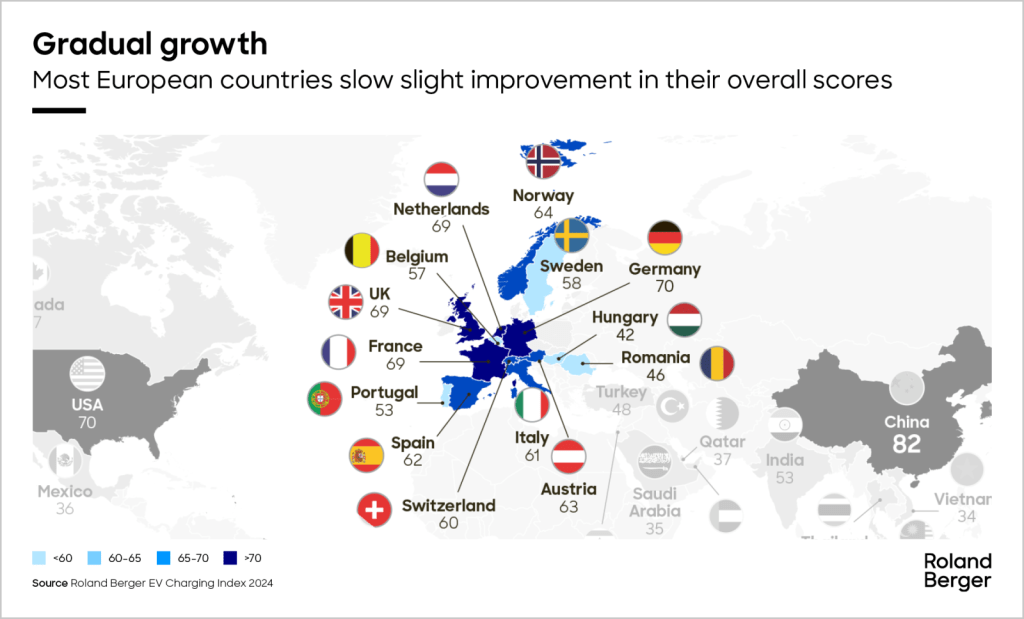
According to Roland Berger’s latest EV Charging Index report, Romania’s score rose by seven points, reflecting a significant improvement in customer satisfaction with the charging experience.
However, further development in public charging infrastructure and an accelerated increase in EV adoption are necessary for Romania to fully realise its potential in e-mobility, Roland Berger suggests.
A growing market
In 2023, Romania‘s EV market continued to grow, although at a slower pace compared to previous years. Over 15,000 new fully electric vehicles were registered, marking a 33% increase from 2022.
Subsidies played a crucial role in driving this growth, while market competition increased with a wider range of fully electric (BEV) and plug-in hybrid (PHEV) models available. Around 40% of new passenger car models sold in Romania are now chargeable.
In addition, Romania’s charging infrastructure saw a 50% year-on-year increase in the number of charging locations.
The country has a strong penetration of fast charging infrastructure, double the European average. However, the slight decline from 2022 was mainly due to the commissioning of numerous AC charging points financed through government initiatives.
Public charging is slightly more popular in Romania than elsewhere in Europe, aligning with the lower penetration of home charging infrastructure in the country. Romanian EV drivers generally express high satisfaction with the overall charging experience, although concerns about charging speeds remain.
Global EV adoption
Overall, Roland Berger’s EV Charging Index report found that China still ranks highest on a global level when it comes to EV adoption, followed by Germany, the United States, and the Netherlands, all of which have seen numbers either ‘stagnate’ or ‘decrease’ in the past year.
‘Global sales penetration rates continued to rise in 2023, but there was strong variance across countries, influenced by factors in policy, supply, and demand,’ Roland Berger said. ‘Asian countries and the Middle East saw the biggest rises, but South Korea and Germany both saw sales penetration rates decline.’