The European Union imported €95.3 billion worth of energy products in the first quarter of 2025, equating to a total volume of 176.4 million tonnes.
The value of imports were 0.3% higher than in the corresponding period a year earlier, while volumes were down 3.9%, the Eurostat data showed.
Imports by energy type
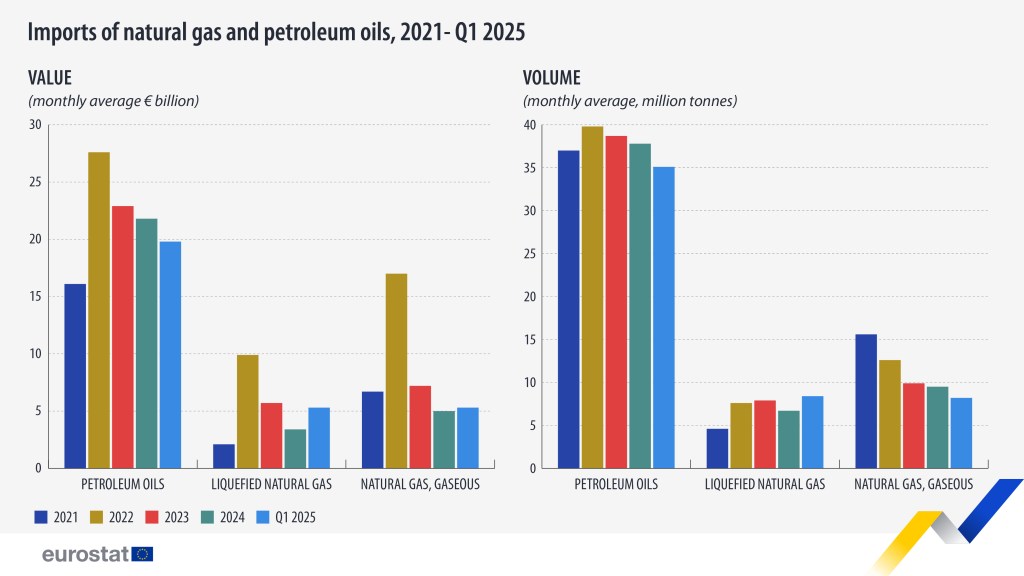
Imports weren’t consistent across different energy types, however, with imported petroleum seeing a decline in both value (-11.9%) and volume (-8.0%) in the first quarter, while imported liquefied gas saw notable increases in value (+45.3%) and volume (+12.1%).
Elsewhere, imported natural gas in a gaseous state reported a 19.0% increase in value, while volume decreased by 12.1%.
Key import partners
The main partners for EU imports of petroleum oils were the United States, which accounted for 15.0% of imports by value, Norway (13.5%) and Kazakhstan (12.7%), with Libya (+1.9 pp) and Kazakhstan (+1.8 pp) seeing the biggest year-on-year increase.
The US was also responsible for half the imports of liquefied natural gas (50.7% by value), ahead of Russia (17.0%) and Qatar (10.8%), with the latter seeing its share rise by 1.7 percentage points.
Norway was the biggest supplier of natural gas in a gaseous state, accounting for 52.6% of the total, followed by Algeria (19.4%) and Russia (11.1%).
‘Until the end of 2021, Russia was the main supplier of petroleum oils and natural gas to the EU,’ Eurostat noted. ‘After Russia’s invasion of Ukraine, the European Union reacted with several packages of sanctions, which directly and indirectly affected the trade of oils and natural gas. A major diversification of suppliers started to emerge progressively in the following periods.’ Read more here and here.