The average monthly gross wage in Estonia stood at €1,959 in the third quarter of 2024, an 8.1% increase on the same period last year, new data from Statistics Estonia has found.
Median wages for the quarter stood at €1,620, up from €1,500 in Q3 2023, the data showed.
‘Slower growth’
“Looking at the wage change trend, wage growth is still slower now than in 2023,” commented Sigrid Saagpakk, analyst at Statistics Estonia.
Remuneration varied significantly across different sectors, with the highest average monthly gross wages and salaries reported in information and communication (€3,506), followed by financial and insurance activities (€3,068), and electricity, gas, steam, and air conditioning supply (€2,540).
At the same time, the lowest average monthly gross wages and salaries were recorded in accommodation and food services (€1,285), other service activities (€1,311), and real estate activities (€1,366).
“Compared with the same period last year, wages and salaries increased the most in human health and social work activities (10.6%) and in education (9.6%),” Saagpakk added.
Regional disparities
The data also indicates a number of regional differences, with the highest average wages recoded in the capital, Tallinn, at €2,307, followed by neighbouring Harju county (€2,200).
The lowest wages, meanwhile, were observed in Valga (€1,452), Võru (€1,477), and Lääne (€1,485).
“Wage growth varies by county, but compared with the same period last year, wages and salaries now increased the most in Hiiu (10.7%), Tartu (9.7%) and Ida-Viru (9.1%) counties,” Saagpakk added.
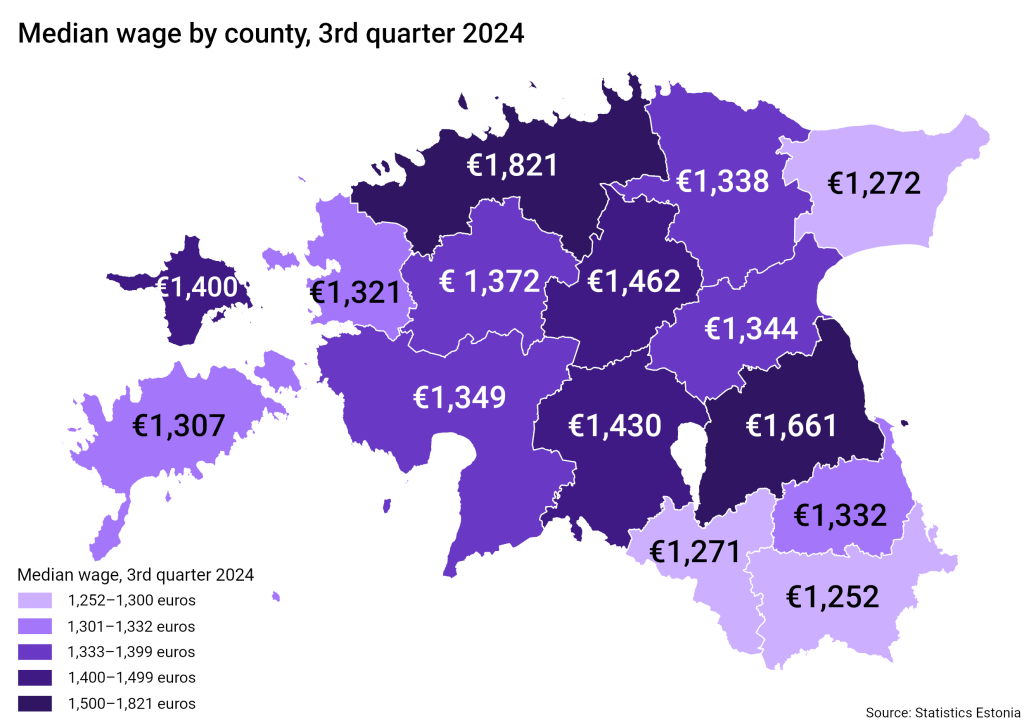
The highest median wages were seen in Tallinn (€1,900), followed by Harju county (incl. Tallinn, €1,821) and Tartu county (€1,661). Median wages were the lowest in Võru (€1,252), Valga (€1,271), and Ida-Viru (€1,272).
The data is based on information from the employment register of Estonia’s tax and customs board, as well as income tax declarations. Read more here.