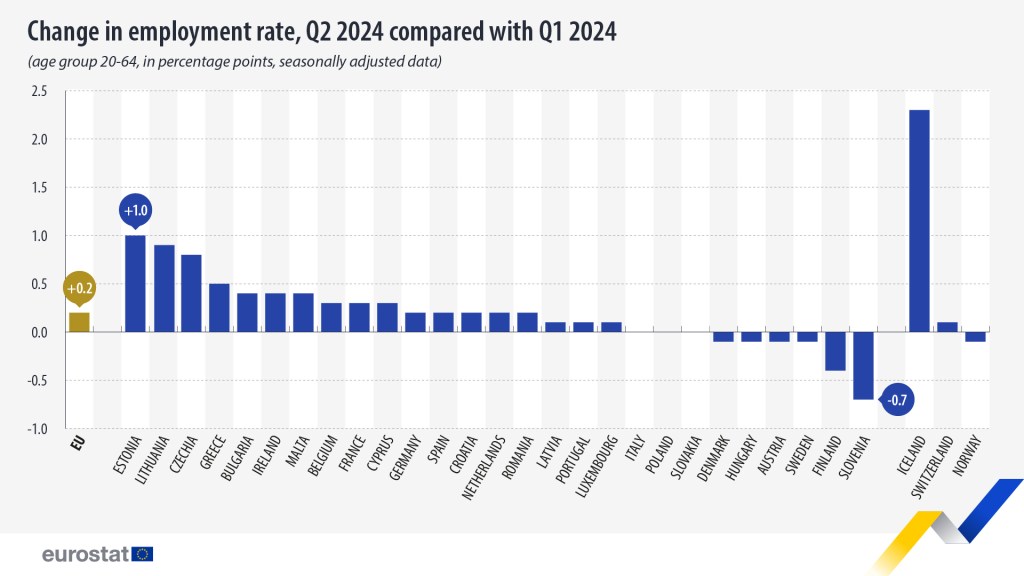
Estonia reported the highest increase in employment rate in the European Union in the second quarter of 2024, compared to the previous quarter, seeing a 1.1 percentage point rise, according to new data from Eurostat.
Other countries to see a notable increase in employment rate included Lithuania (+0.9 percentage points) and Czechia (+0.8 percentage points).
Six EU countries reported a quarter-on-quarter decline in employment rate, with Slovenia (-0.7 percentage points) and Finland (-0.4 percentage points) seeing the biggest declines.
The unemployment rate remained unchanged in Italy, Poland and Slovakia.
Overall employment rate
Overall, in the second quarter of 2024, the employment rate for people aged 20-64 in the European Union was 75.8%, a 0.2 percentage point increase from the first quarter of 2024, Eurostat noted.
Labour market slack, which includes those with unmet employment needs such as unemployed individuals, stood at 11.0% of the extended labour force aged 20-64, a decrease of 0.1 percentage points from the previous quarter.
Elsewhere, recent data shows that Malta has the highest percentage of recent graduates entering the workforce, with 95.8% now employed. Other European countries with a high percentage of recent graduates in employment include the Netherlands (93.2%), Germany (91.5%), Austria (89.0%), Ireland (88.7%), and Hungary (87.9%).
Employment rate by European Union country (%)
| Country | 2023-Q1 | 2023-Q2 |
|---|---|---|
| Belgium | 72.3 | 71.6 |
| Bulgaria | 76.6 | 76.3 |
| Czechia | 81.3 | 82.0 |
| Denmark | 80.1 | 79.6 |
| Germany | 80.9 | 81.3 |
| Estonia | 82.4 | 82.3 |
| Ireland | 79.1 | 79.4 |
| Greece | 67.3 | 67.4 |
| Spain | 69.8 | 70.6 |
| France | 74.3 | 74.5 |
| Croatia | 70.2 | 70.9 |
| Italy | 65.9 | 66.1 |
| Cyprus | 79.7 | 79.6 |
| Latvia | 77.1 | 77.6 |
| Lithuania | 77.7 | 79.0 |
| Luxembourg | 75.0 | 75.4 |
| Hungary | 80.6 | 80.7 |
| Malta | 80.8 | 80.6 |
| Netherlands | 83.5 | 83.5 |
| Austria | 77.2 | 77.2 |
| Poland | 77.6 | 77.7 |
| Portugal | 77.5 | 78.0 |
| Romania | 68.7 | 68.5 |
| Slovenia | 76.5 | 78.0 |
| Slovakia | 77.4 | 77.5 |
| Finland | 78.5 | 78.6 |
| Sweden | 82.7 | 82.7 |