

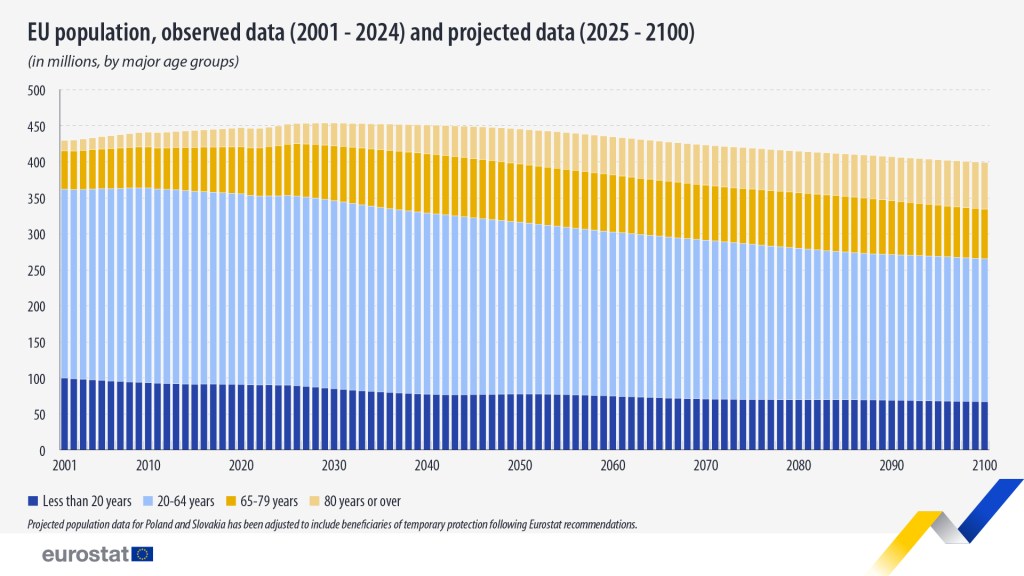
The population of the European Union is projected to fall by 11.7% by the year 2100, new data from Eurostat has revealed.
This equates to an anticipated population decrease of 53 million people by the end of the century, the data showed.
As of 2025, the EU population stood at an estimated 451.8 million people. It is expected to grow slightly in the short term, reaching a peak of 453.3 million in 2029.
After that point, the population is projected to decline steadily, falling to 398.8 million by 2100.
Ageing population
At the core of the projections is the general ageing of the EU’s population. The share of younger people (aged between 0 and 19) is expected to decline, falling from 20% of the population in 2025 to 17% by 2100.
At the same time, the proportion of people aged 20 to 64, typically considered the working-age population, is projected to decrease from 58% to 50%.
In contrast, the share of people aged 65 to 79 is forecast to rise slightly, while the proportion of those aged 80 and over is projected to increase significantly, from 6% to 16% of the total population.
Population pyramid
Population structure is often illustrated through a population pyramid, which shows the distribution of age groups. In 2025, the EU’s population pyramid already reflects low birth rates and a relatively large number of people in older working-age groups.
By 2100, the structure is expected to change further, with a narrower base and a wider top, indicating fewer young people and a larger elderly population.

‘Eurostat’s population projections result from a set of assumptions on future developments for fertility, mortality, and net migration,’ it noted. ‘In other words, population projections are ‘what-if’ scenarios that track population developments under a set of assumptions. For this reason, population projections should not be considered as forecasts.
‘Given the intrinsic uncertainty of future population dynamics, such results should be interpreted as only one of a range of possible demographic developments.’ Read more here.


